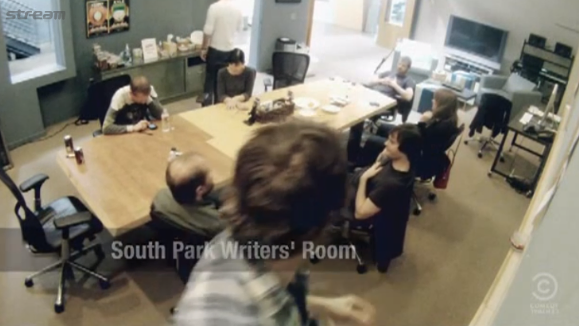
A look behind the scenes
The documentary “6 days to air” offers a unique look behind the scenes of the South Park team. Their production process turns out to be super efficient and has a lot in common with agile development.
The makers of South Park do not like onlookers while making a new episode. Fortunately, they made an exception for their friend Arthur Bradford.
Six days to air
Arthur’s documentary follows producers Trey Parker and Matt Stone during the making of the first episode of the 15th season. Six days before the episode is broadcast, we see the makers hold a brainstorm session. All kinds of ideas pass by, until Trey starts talking about his frustrations with downloading the latest iTunes. Having to accept the terms and conditions over and over again eventually leads to the episode “Humancentipad”.
The day before the broadcast, the team is still working on the script. After the last word is written, the animators and voice actors are busy until 7 o’clock in the morning. Synchronizing picture and sound takes until late in the afternoon. The episode is finally uploaded to the television station only a few hours before the broadcast.
While watching, it is striking how much the South Park production process has in common with software development. I will highlight my favorites.
Deadlines
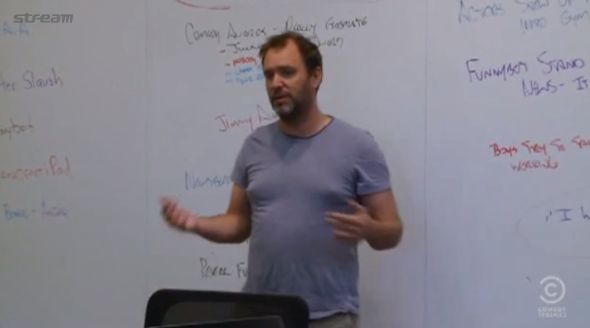
At some point Trey Parker says the following:
I always feel like that I wish we had another day with this show. That is the reason that we get so much episodes done. Because there is a deadline, you can’t keep going. Otherwise I would spend 4 weeks on a show, which would only be 5% better
What Trey describes will sound familiar to many agile developers. Near the end of the sprint there always seems to be too little time to get all stories shippable. However, most of the stories, and especially the most important ones, can be shipped. That is what matters! Without a deadline, a marginally better product would be realized in a lot more time. A deadline gives focus.
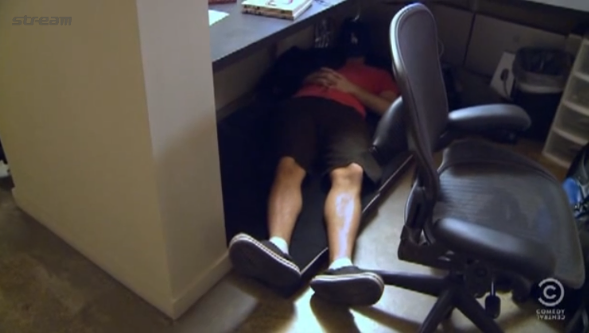
While watching I wondered how they keep up the pace, because it does not really look like a “sustainable pace”. In the last days before delivery there is little sleep and a lot of stress. You even see team members sleeping under their desks. Maybe it works because only 10 episodes per year are broadcast and they can rest for the remainder of the year?
Speed gives agility
Making the first episode of South Park took more than a month. From that moment the team became more and more efficient, until an episode took 2 weeks, then only 10 days, then 7 and finally 5 days. This is more than 25 times faster than making an episode of The Simpsons!
The process is so efficient that the limiting factor is the creativity of the writers, not the time needed for scripts, storyboards, drawing, coloring and voice acting.
Because they are so fast, they can respond to current events. Their agility gives them an advantage over other shows, like The Simpsons, which can never comment directly on the news.
Multidisciplinary teams
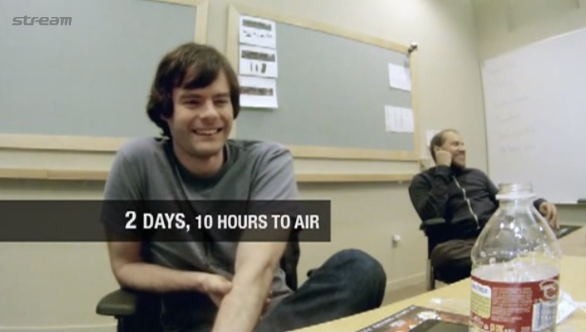
A traditional studio has a separate department for each discipline. Think of a department for making storyboards, a department for coloring and a department for character development. At South Park everybody does everything, from drawing the characters to voicing them.
Everybody does everything in 1/10th of the time.
This multidisciplinary approach has several advantages. There are no walls that make communication difficult, there is no handover, there is 1 team with 1 goal. Because everybody is familiar with all disciplines, all delivered work fits together better.
The danger of wanting too much
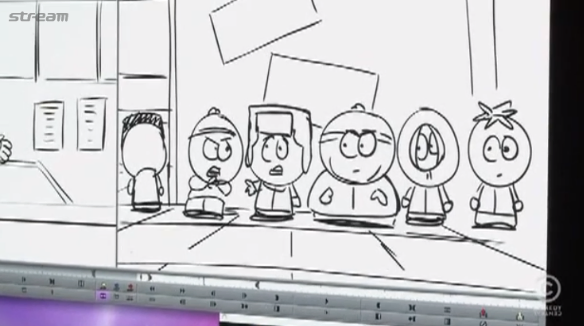
A danger the team is familiar with is “The danger of too many ingredients”. Trey refers to the trial episode. In this episode they wanted to cover so many subjects that at some point they could not get out of it anymore. They ran out of time and money, which put the whole episode at risk. This example underlines the importance of KISS (Keep It Simple, Stupid) and of aiming for a minimum viable product (MVP).
The team as a band
The makers sometimes compare their team to a band. They are well attuned to each other and bring out the best in each other. Matt really needs Trey to function at his best (“whatever I have is channeled through him”).
A good team does not arise from putting random people together. The members must complement each other and there has to be a certain balance. In this context, the list of management guru Belbin is interesting. He distinguishes 9 different roles within a team:
- Implementer: the down-to-earth doer
- Resource Investigator: the enthusiastic networker and “idea connector”
- Monitor Evaluator: the thoughtful analyzer
- Plant: the creative solo player
- Shaper: the driving force
- Coordinator: the neutral organizer
- Team Worker: the warm keeper of the atmosphere
- Completer Finisher: the perfectionist who finishes things
- Specialist: the expert in their own field
The studio understands how important it is that the team functions well, and facilitates the best possible environment:
This place is built around them being a completely self sufficient organisation.
The team is self-organizing and also has the mandate to make important decisions. Sounds a lot like Scrum!
The importance of feeling safe
You gotta feel safe
Within the team it is considered very important that you can feel safe. Especially in “the writers room”, where a lot of brainstorming takes place, you should not be afraid to say something. Trey indicates that of the 100 ideas that are suggested, only a few can be used in the show. That is why this room is a “safe place”. Without an uninhibited flow of ideas, production gets stuck, or at least the quality goes down.
Feeling safe within a software development team is of course just as important. Ideas are needed to solve incidents and problems, but also to start technical innovations or to discover new customer features.